Modeling introspection, Spin representations, ND
Andrius Kulikauskas: I am overviewing
Bott periodicity interpretations
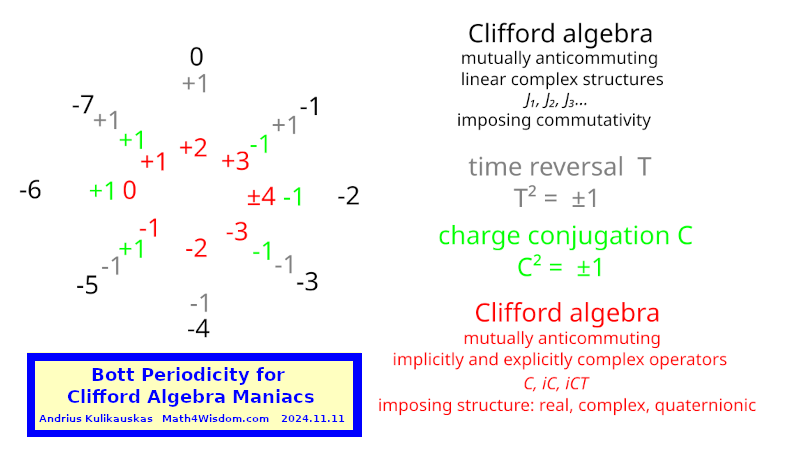
Centered on {$\mathbb{R}\oplus\mathbb{R}$}
In the middle between left {$\mathbb{R}$} and right {$\mathbb{R}$}.
Consciousness relates unconscious and conscious. All three square to {$+1$} at the start.
{$S=TC$}
- {$(J_1J_6J_7)(J_2J_4J_6)=J_1J_2J_4J_7$}
- {$(J_2J_4J_6\otimes J_1)(J_2J_4J_6)=?$}
- {$(J_3)(J_2)=-J_2J_3$}
- {$(J_2J_4J_5)(J_2)=-J_4J_5$}
Mappings
The Chevalley action is from the number of perspectives on the number of shifts in perspective.
We are working with complex Clifford algebras and the generators square to {$+1$}.
Centered on left {$\mathbb{R}$}, with 8 generators {$e_{\pm j}^2=\pm1$}
Time reversal: Accessible. Unconscious mind.
Super division algebras
Three minds
- The direct mind is given by the even subalgebra and the indirect mind is given by the odd subalgebra.
- The concept of choice (and reflection) is encoded by the generator {$e$} for the odd part of the super algebra.
Automorphisms are defined by {$a\rightarrow a'$} where {$ae=ea'$}.
Consider what it means for the even subalgebra of {$Cl_{0,4}\cong Cl_{4,0}$} to be isomorphic to {$\mathbb{H}$}.
Centered on right {$\mathbb{R}$}, with 8 generators {$e_{\pm j}^2=-1$}
Charge conjugation: Inaccessible. Conscious mind.
Mutually anticommuting linear complex structures.
Centered on {$\mathbb{R}$}, with 8 generators {$e_j^2=-1$}
Eighth roots of unity {$e^{-\frac{\pi}{4}i}$}
{$e^{-\frac{\pi}{4}i}=\frac{\sqrt{2}}{2}(1-i)$}
{$(1-i)^k$}
Consider analogous recursion formula for Clifford algebra representations.
Linear complex structures
Centered on {$\mathbb{R}$}, with 8 generators {$e_j^2=1$}
Eighth roots of unity {$e^{\frac{\pi}{4}i}$}
{$e^{\frac{\pi}{4}i}=\frac{\sqrt{2}}{2}(1+i)$}
{$(1+i)^k$}
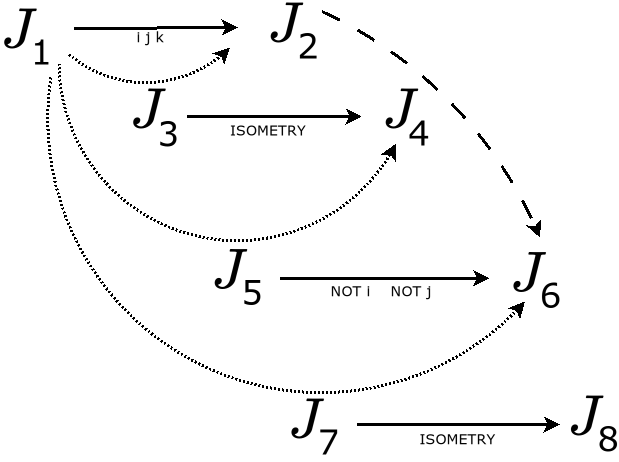
Note that this construction distinguishes the final linear complex structure. That final complex structure {$J_k$} is distinguished by the Hamiltonian {$H=im$}, where {$m$} commutes with {$J_j$} for {$1\leq j<k$} but anticommutes with {$J_k$}.
The Hamiltonian indicates that we are inside the division of everything, experiencing it. Indeed, we are experiencing the last stage of it, the defining stage.
Shifts in perspective
Consider four shifts in perspective: {$J_1J_2$}, {$J_3J_4$}, {$J_5J_6$}, {$J_7J_8$}
First shift in perspective
{$J_1J_2=ij=k$} is a pseudoscalar.
Second shift in perspective
{$J_3J_4=L=\begin{pmatrix} 0 & I_4 \\ -I_4 & 0\\ \end{pmatrix}$} is an isometry. It is central in the interpretation in terms of the octonions. It is the looking glass.
Third shift in perspective
{$J_5J_6=\begin{pmatrix} F_4 & 0 \\ 0 & -F_4 \\ \end{pmatrix}$} where {$F_4=\begin{pmatrix} 0 & J1_2 \\ J1_2 & 0 \\ \end{pmatrix}$}
This brings us to the sixsome with its three-cycle.
The sevensome can be thought of as expressing this third shift explicitly with the seventh perspective, which relates two triplets, one of which is a three-cycle given by the final states of the shifts.
Fourth shift in perspective
{$J_7J_8=\begin{pmatrix} 0 & I_8 \\ -I_8 & 0\\ \end{pmatrix}$} is an isometry.
{$A_i=J_i^{-1}J_{i+1}$} is a shift in perspective.
Isometries
{$J_3=\begin{pmatrix} -k & 0 \\ 0 & k\\ \end{pmatrix}, J_4=\begin{pmatrix} 0 & k \\ k & 0 \\ \end{pmatrix}, L=J_3J_4=\begin{pmatrix} 0 & I_4 \\ -I_4 & 0 \\ \end{pmatrix}$}
{$D=\textrm{diag}[1,-1,-1,1]$}
{$R=\begin{pmatrix} 0 & -D \\ D & 0\\ \end{pmatrix}$}
{$J_7=\begin{pmatrix} -R & 0 \\ 0 & R\\ \end{pmatrix}, J_8=\begin{pmatrix} 0 & R \\ R & 0 \\ \end{pmatrix}, L_2=J_7J_8=\begin{pmatrix} 0 & I_8 \\ -I_8 & 0 \\ \end{pmatrix}$}
Product of three generators
Such a product squares to {$+1$}. So it breaks up the space into two subspaces, possibly zero, with eigenvalues {$+1$} or {$-1$}. And it defines a three-cycle which turns in opposite directions on those subspaces. And so that makes the three-cycle unidirectional.
The three-cycle can be understood as identifying a shift-in-perspective with a third perspective. Permutations yield the three-cycle.
If we think of a structure as an ordered sequence of shifts in perspective, then we can define a shift-in-perspective for the entire structure, which starts with the initial perspective in the first shift-in-perspective and ends with the final perspective in the last shift-in-perspective. And then we identify this with an additional perspective. This yields:
- {$J_1J_2J_3=K$} the start of the first shift to the end of the first shift
- {$J_1J_4J_5=M$} the start of the first shift to the end of the second shift
- {$J_1J_6J_7=P$} the start of the first shift to the end of the third shift
There is also a three-cycle that relates the final states of all three shifts-in-perspective: {$J_2J_4J_6=N$}
A three-cycle identifies a shift-in-perspective with a perspective. Thus it is both a perspective and a shift-in-perspective. It squares to {$+1$} as a quantum symmetry. Whereas a single perspective squares to {$-1$} as a quantum symmetry.
A triple product can be diagonalized so that its nonzero entries are on the diagonal and the values are {$1$} or {$-1$}.
- {$J_1J_2J_3=\textrm{diag}[1,1,1,1,-1,-1,-1,-1]$}
- {$J_1J_2J_4=\begin{pmatrix} 0 & -I_4 \\ -I_4 & 0 \\ \end{pmatrix}$}
- {$J_1J_3J_4=\begin{pmatrix} 0 & J1_4 \\ -J1_4 & 0 \\ \end{pmatrix}$}
- {$J_2J_3J_4=\begin{pmatrix} 0 & J2_4 \\ -J2_4 & 0 \\ \end{pmatrix}$}
- {$J_1J_2J_5=\begin{pmatrix} 0 & T_4 \\ -T_4 & 0 \\ \end{pmatrix}$} where {$T_4=\begin{pmatrix} -J1_2 & 0 \\ 0 & J1_2 \\ \end{pmatrix}$}
- {$J_1J_3J_5=\begin{pmatrix} 0 & U_4 \\ U_4 & 0 \\ \end{pmatrix}$} where {$U_4=\begin{pmatrix} -I_2 & 0 \\ 0 & I_2 \\ \end{pmatrix}$}
- {$J_1J_4J_5=\textrm{diag}[-1,-1,1,1,1,1,-1,-1]$}
- {$J_2J_3J_5=\begin{pmatrix} 0 & Z_4 \\ Z_4 & 0 \\ \end{pmatrix}$}
- {$J_2J_4J_5=\begin{pmatrix} Z_4 & 0 \\ 0 & -Z_4 \\ \end{pmatrix}$} where {$Z_4=\begin{pmatrix} 0 & Z_2 \\ Z_2 & 0 \\ \end{pmatrix}$} and {$Z_2=\begin{pmatrix} 0 & 1 \\ 1 & 0 \\ \end{pmatrix}$}
- {$J_3J_4J_5=\begin{pmatrix} Y_4 & 0 \\ 0 & Y_4 \\ \end{pmatrix}$} where {$Y_4=\begin{pmatrix} 0 & R_2 \\ R_2 & 0 \\ \end{pmatrix}$}
- {$J_1J_2J_6=\begin{pmatrix} 0 & W_4 \\ W_4 & 0 \\ \end{pmatrix}$} where {$W_4=\begin{pmatrix} 0 & I_2 \\ -I_2 & 0 \\ \end{pmatrix}$}
- {$J_1J_3J_6=\begin{pmatrix} 0 & V_4 \\ -V_4 & 0 \\ \end{pmatrix}$} where {$V_4=\begin{pmatrix} 0 & -J1_2 \\ J1_2 & 0 \\ \end{pmatrix}$}
- {$J_1J_4J_6=\begin{pmatrix} -V_4 & 0 \\ 0 & -V_4 \\ \end{pmatrix}$}
- {$J_1J_5J_6=\begin{pmatrix} -Q_4 & 0 \\ 0 & Q_4 \\ \end{pmatrix}$} where {$Q_4=\begin{pmatrix} 0 & I_2 \\ I_2 & 0 \\ \end{pmatrix}$}
- {$J_2J_3J_6=\begin{pmatrix} 0 & P_4 \\ -P_4 & 0 \\ \end{pmatrix}$} where {$P_4=\begin{pmatrix} R_2 & 0 \\ 0 & R_2 \\ \end{pmatrix}$}
- {$J_2J_4J_6=\textrm{diag}[-1,1,-1,1,-1,1,-1,1]$}
- {$J_2J_5J_6=\begin{pmatrix} -N_4 & 0 \\ 0 & N_4 \\ \end{pmatrix}$} where {$N_4=\begin{pmatrix} Z_2 & 0 \\ 0 & -Z_2 \\ \end{pmatrix}$}
- {$J_3J_4J_6=\begin{pmatrix} E_4 & 0 \\ 0 & -E_4 \\ \end{pmatrix}$} where {$E_4=\begin{pmatrix} Z_2 & 0 \\ 0 & Z_2 \\ \end{pmatrix}$}
- {$J_3J_5J_6=\textrm{diag}[-1,1,1,-1,-1,1,1-1]$}
- {$J_4J_5J_6=\begin{pmatrix} 0 & -G_4 \\ G_4 & 0 \\ \end{pmatrix}$} where {$G_4=\begin{pmatrix} R_2 & 0 \\ 0 & -R_2 \\ \end{pmatrix}$}
- {$J_1J_6J_7=?$}
I can study what it takes to diagonalize these and what the eigenvectors look like. For example:
{$\begin{pmatrix} \frac{\sqrt{2}}{2}I_4 & \frac{\sqrt{2}}{2}I_4 \\ \frac{\sqrt{2}}{2}I_4 & -\frac{\sqrt{2}}{2}I_4 \\ \end{pmatrix}\begin{pmatrix} 0 & -I_4 \\ I_4 & 0 \\ \end{pmatrix}\begin{pmatrix} -\frac{\sqrt{2}}{2}I_4 & -\frac{\sqrt{2}}{2}I_4 \\ -\frac{\sqrt{2}}{2}I_4 & \frac{\sqrt{2}}{2}I_4 \\ \end{pmatrix} = \begin{pmatrix} I_4 & 0 \\ 0 & -I_4 \\ \end{pmatrix}$}
And the eigenvalues and eigenvectors are {$-1(v,v)$} and {$1(v,-v)$}.
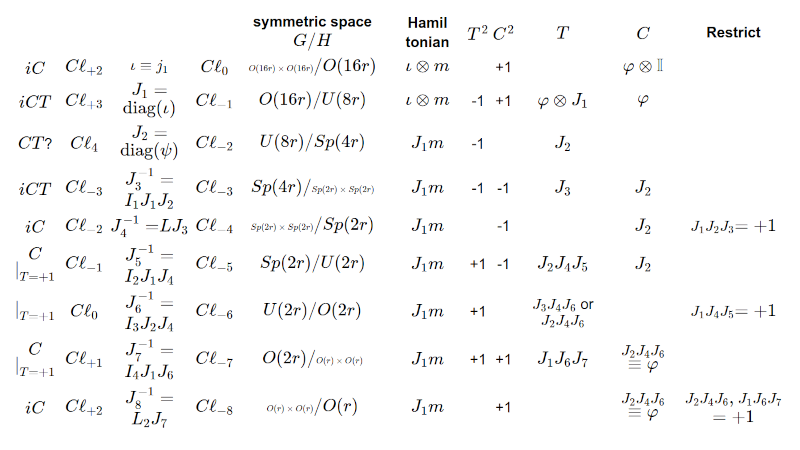
Real structure {$\varphi$} and the three-cycle {$J_2J_4J_6$}
We need a real structure {$\varphi$}, an antilinear map {$\varphi(\lambda v)=\lambda^*\varphi(v)$} such that {$\varphi^2=\mathbb{I}$}. This allows us to decompose {$V=W\oplus_\mathbb{R}iW$} where {$W=\{v\in V:\varphi(v)=v\}$} and {$iW=\{v\in V:\varphi(v)=-v\}$}. This lets us break up the vectors of {$V$} into a real basis {$e_n$} spanning {$W$} and an imaginary basis {$ie_n$} spanning {$iW$}.
{$\varphi$} takes various forms in various circumstances. For example:
{$\varphi = \begin{pmatrix} \mathbb{I} & 0 \\ 0 & -\mathbb{I} \\ \end{pmatrix} = \sigma_3\otimes\mathbb{I}$} which is important in defining {$J_9$} and the collapse of the eight-cycle. Here the Hamiltonian is {$H = \begin{pmatrix} \mathbb{I} & 0 \\ 0 & -\mathbb{I} \\ \end{pmatrix}$} and its eigenvectors {$v=\pm(w,w)$} and {$iv=\pm(w,-w)$} should not be considered distinct. {$\varphi$} is the charge conjugation (particle-hole) symmetry.
The three-cycle {$J_2J_4J_6=\varphi=N$} structures the sixsome. We take it to be the real structure when we double the space, which we need to do. The three-cycle then plays the role of the charge conjugation symmetry, setting up two parallel worlds: particles and holes. The two minds are parallel, what is known and what is not known.
Universal
John Harland: Bott periodicity and recursion
- Thue-Morse sequence
{$K_1=1$}
{$J_{j-1}= \begin{pmatrix} 0 & -K_{j-1}^T \\ K_{j-1} & 0 \\ \end{pmatrix}$}
{$K_j=\begin{pmatrix} K_{j-1} & -0 \\ 0 & -K_{j-1}\\ \end{pmatrix}$}
{$k_1=1$}
{$k_j=k_{j-1},-k_{j-1}$}
These representations are reducible. What is the structure that describes their reducibility? Note that Stone et al's diagonal matrices {$K, M, N, P$} may be relevant.